
Get Support
02 9822 0155
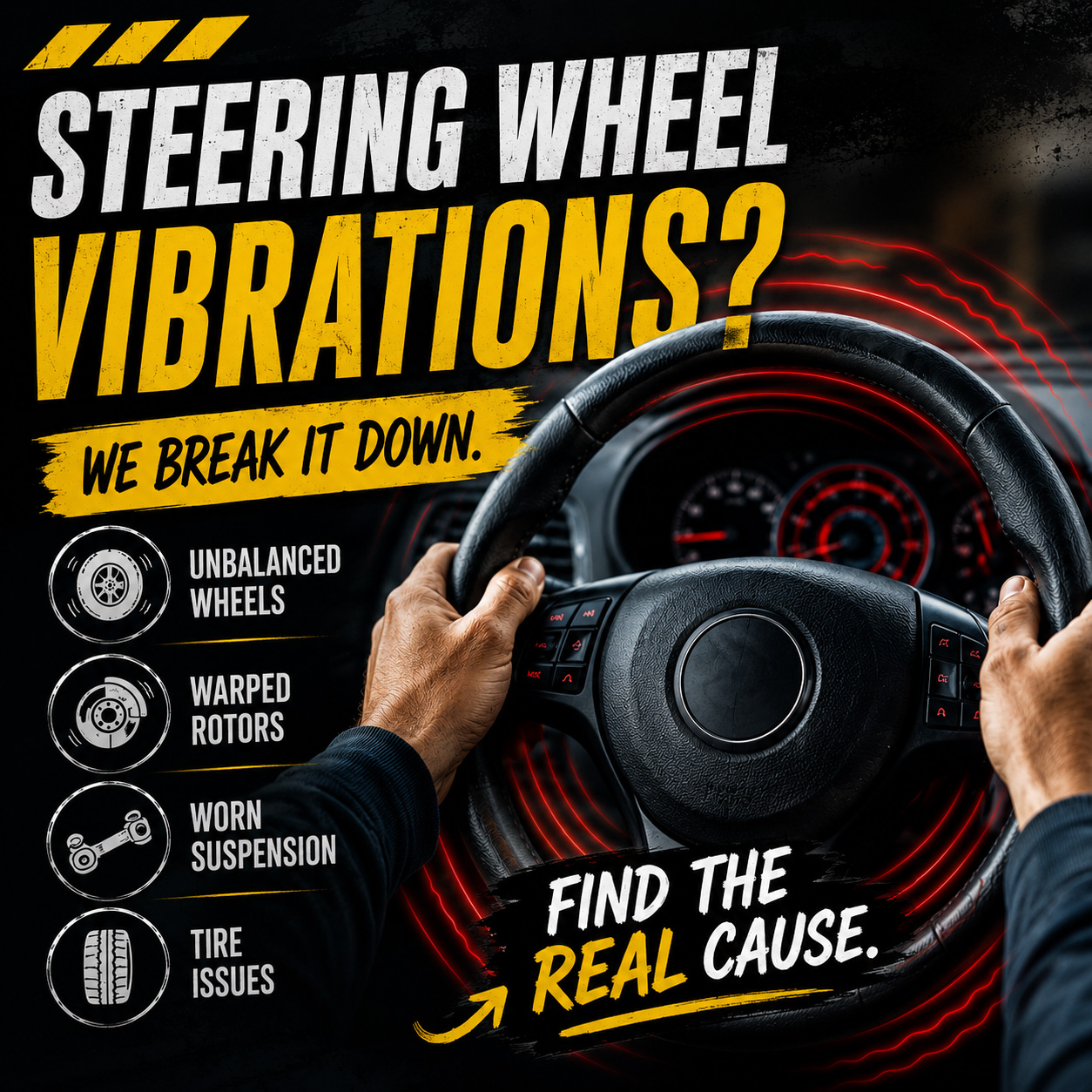
Imagine you’re driving along, not paying much attention, when suddenly the steering wheel in your hands begins to shake. It could be just a very slight vibration that you hardly notice. Or it could be shaking so hard that you can even see the motion blur. Either way, the small movement is your vehicle communicating to you and it really makes sense to pay attention to it.
At our mechanic, steering wheel vibration is among the top issues that we get reported by vehicle owners near the Cabramatta and Fairfield regions. What makes it complicated is that the vibration can be due to a number of reasons and there is a single fix for only one of the issues. It is a symptom and if we consider the time of occurrence and the sensation, then the reason can be a simple $40 wheel balancing or a more complicated problem related to brakes or suspension. So what is really happening under the hood?
Unbalanced Wheels: The Usual Suspect
If your steering wheel shakes mostly at higher speeds, say anywhere from 80 to 110 km/h, and smooths out again once you slow down, wheel balance is almost always the culprit. Every tyre and wheel assembly has small weights attached to it to make sure the weight is spread evenly around the circle. Over time, hitting potholes, kerbs, or just general wear can knock those weights loose or wear the tyre unevenly, throwing the whole thing out of balance.
An unbalanced wheel doesn’t spin smoothly. It wobbles ever so slightly with every rotation, and at speed, that wobble translates straight into the steering wheel. The fix here is usually simple and cheap: a wheel balance on a proper machine sorts it out in about twenty minutes per wheel.
Tyre Problems You Can’t Always See
Occasionally, it is not a balance problem per se but the tyre. Irregular tread wear, a bulge in the sidewall of the tyre or even the tyre itself becoming separated inside (where the internal steel or fabric layers start to come apart) are capable of causing vibrations. A belt separation is very deceptive because the tyre may appear totally normal on the outside while it is disintegrating inside.
Another one that is very typical is cupping. It is a phenomenon when a tyre is worn in a scalloped or wavy pattern, not uniformly across the tread. It generally indicates that the worn suspension components, which are supposed to keep the tyre firmly planted on the road, are out of order. Therefore, the tyre being the symptom, the vibration may originally be due to something completely different.
Brake Trouble at Lower Speeds
If the shaking shows up specifically when you brake, especially a pulsing feeling through the steering wheel or even the whole car, you’re likely looking at warped brake rotors. Rotors can develop uneven surfaces from heat cycling, especially if you do a lot of stop-start driving or towing. When the brake pad grips an uneven rotor, it creates that pulsing sensation rather than a smooth, even stop.
This is one we take seriously, because it’s directly tied to your ability to stop safely. Warped rotors don’t fix themselves, and driving on them longer than necessary just accelerates wear on your pads and callipers too.
Suspension and Steering Components
Vibration that intensifies as speed drops or even persists at idle, typically the suspension or steering system is to blame, not the tyres. Old control arm bushings, a failing CV joint, loose tie rod ends or a worn-out wheel bearing are all capable of causing play and vibration in the system.
Moreover, a failing CV joint often gets worse the more you turn, so if you notice more shudder when you turn the corners, that’s a pretty solid clue.
Wheel bearings are also a frequent culprit. A bearing that is close to failing will often produce a low humming or growling sound changing its pitch as your speed changes, besides the vibration. If you continue ignoring it, a bearing failure can eventually cause a wheel to lock up or, laying it open, come loose completely. Definitely not to be postponed.
Engine-Related Causes
Not every vibration is about the wheels at all. Sometimes it’s the engine. A vibration that’s present even when the car is stationary and idling, rather than only while driving, often points to engine mounts, a dirty or failing spark plug, or a clogged air filter affecting how smoothly the engine runs. Motor mounts wear out over time and stop absorbing engine vibration the way they’re supposed to, letting it travel straight through the chassis and into the cabin.
Wheel Alignment
Alignment issues themselves don’t always cause vibration directly, but a car that’s badly out of alignment tends to wear tyres unevenly, and uneven tyre wear absolutely does cause vibration. If you’ve noticed your car pulling slightly to one side along with the shake, alignment is worth checking alongside everything else.
So What Should You Actually Do?
Here’s a simple way to think about it. Ask yourself when the vibration happens:
- Only at highway speed? Start with a wheel balance and tyre inspection.
- When braking? Get your rotors checked before you drive much further.
- At low speed or while turning? Suspension and CV joints need a look.
- While idling, parked? Engine mounts or a rough-running engine could be to blame.
None of these are things you want to guess at for too long. A vibration that seems minor today can be a sign of a component that’s wearing out fast, and catching it early is almost always cheaper and safer than waiting for it to get worse.
Don’t Wait Until It Gets Worse
Steering wheel vibration is your car’s way of raising its hand and saying something isn’t quite right. Sometimes it’s nothing more than a quick wheel balance. Other times it’s an early warning about brakes, bearings, or suspension parts that are close to failing. The only real way to know for sure is to get it looked at properly.
If you’re noticing any shaking, shuddering, or pulsing through your steering wheel, don’t just turn the radio up and ignore it. Bring your car in and let us take a proper look, diagnose the actual cause, and get you back on the road with confidence.
Book a diagnostic check with Mt Pritchard Automotive today and drive with peace of mind.
